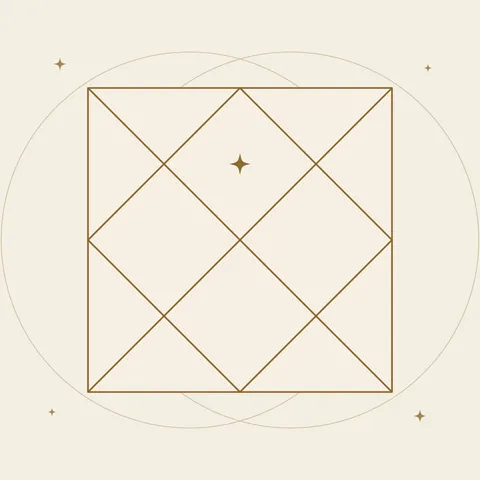
A kundli, the Hindi word for a birth chart, can look quite different depending on the region it comes from or the software that drew it. Two layouts are used most often: the North Indian diamond and the South Indian grid. Both show the same birth data. This article compares how each one places that data and how to find your way around either.
The one idea that separates the two layouts
A Vedic birth chart is calculated from the moment and place of birth. The layout is only the drawing. The planets sit in the same signs whichever format is used.
The difference is what stays fixed on the page:
- North Indian layout: the houses stay in fixed positions, and the signs move around them.
- South Indian layout: the signs stay in fixed boxes, and the houses move around them.
Here a house, or bhava in Sanskrit, is one of twelve life-areas counted from the ascendant. A sign, or rashi, is one of the twelve zodiac divisions. Once you know which of the two is fixed, either chart becomes easier to read.
The North Indian diamond
The North Indian chart is a square with both diagonals drawn across it and a smaller diamond joining the midpoints of the sides. This creates twelve spaces: four diamonds and eight triangles. Each space is one house, and each house keeps its place in every chart.
Finding house 1 and counting on
House 1 is the diamond at the top centre. It holds the ascendant, called the Lagna in Sanskrit, which is the sign rising on the eastern horizon at the time of birth. The houses are then counted anticlockwise:
- House 1: the top centre diamond.
- Houses 2 and 3: the two triangles on the upper left.
- House 4: the diamond on the left.
- Houses 5 and 6: the two triangles on the lower left.
- House 7: the bottom centre diamond.
- Houses 8 and 9: the two triangles on the lower right.
- House 10: the diamond on the right.
- Houses 11 and 12: the two triangles on the upper right.
Because the houses never move, the sign is what changes from chart to chart. Most North Indian charts show it as a small number in each house, from 1 for Aries to 12 for Pisces. The number written in the top diamond tells you the ascendant sign. A 4 there means Cancer, because Cancer is the fourth sign. A reader then goes round the chart in order: 5 for Leo in house 2, 6 for Virgo in house 3, and so on.
The South Indian grid
The South Indian chart is a square divided into a four-by-four grid. The twelve boxes around the edge each hold one sign, and the middle is usually left empty or used for a title. Each sign always has the same box. The table below shows the usual arrangement, with the empty centre cells left blank.
| Pisces | Aries | Taurus | Gemini |
|---|---|---|---|
| Aquarius | Cancer | ||
| Capricorn | Leo | ||
| Sagittarius | Scorpio | Libra | Virgo |
The signs run clockwise in zodiac order, with Aries in the second box of the top row and Pisces in the top-left corner. Since the signs are fixed, you can learn the grid once and it stays the same for every chart.
Finding the ascendant box
In this layout the houses move. The box that holds the ascendant sign is house 1, and the houses follow clockwise from there. Many South Indian charts mark the ascendant box with a diagonal line across the corner or with a short label, though the marking differs between software. If no mark appears, the chart's own details should state the ascendant sign.
Planets are written in the box of the sign they occupy. So a planet in the Leo box is in Leo, and its house depends on where the ascendant box is.
One chart, drawn both ways
Take a chart whose ascendant is Cancer, with the Moon in Scorpio. The table shows where each house falls in both layouts.
| House | Sign | North Indian position | South Indian box |
|---|---|---|---|
| 1 | Cancer | Top centre diamond | Right side, second row |
| 2 | Leo | Upper-left triangle, beside house 1 | Right side, third row |
| 3 | Virgo | Upper-left triangle, on the left edge | Bottom-right corner |
| 4 | Libra | Left diamond | Bottom row, third from left |
| 5 | Scorpio | Lower-left triangle, on the left edge | Bottom row, second from left |
| 6 | Sagittarius | Lower-left triangle, beside house 7 | Bottom-left corner |
| 7 | Capricorn | Bottom centre diamond | Left side, third row |
| 8 | Aquarius | Lower-right triangle, beside house 7 | Left side, second row |
| 9 | Pisces | Lower-right triangle, on the right edge | Top-left corner |
| 10 | Aries | Right diamond | Top row, second box |
| 11 | Taurus | Upper-right triangle, on the right edge | Top row, third box |
| 12 | Gemini | Upper-right triangle, beside house 1 | Top-right corner |
The Moon in Scorpio is in house 5 in both charts. In the North layout it is written in the lower-left triangle on the left edge. In the South layout it is written in the second box from the left on the bottom row. The planet has not moved. Only the drawing has changed.
How to orient yourself in either layout
When a chart is unfamiliar, these steps help:
- Identify the layout. A square crossed by diagonals, with a diamond in the middle, is North Indian. A grid of boxes with twelve around the edge is South Indian.
- Find the ascendant. In the North layout it is the sign shown in the top centre diamond. In the South layout it is the marked box.
- Count the houses from house 1. Go anticlockwise in the North layout and clockwise in the South layout.
- Place each planet by its sign. Work out how many signs it lies from the ascendant sign, counting the ascendant sign as 1. That count is its house.
The fourth step is easy to overlook. Counting by sign keeps the two formats consistent, even when a planet's box looks far from the ascendant mark.
What a layout cannot do
A layout shows a calculation. It cannot correct a wrong input. If the birth time or place is off, the North and South charts will be off in the same way. For this reason it helps to check the birth details first, as explained in before you read your birth chart.
The twelve signs and their rulers are listed in the 12 rashis and their ruling planets, which is handy when you need to name the sign in a box.
For what each house is traditionally associated with, the plain guide to the 12 houses is a useful companion. For a route through a whole chart, from birth details to planets, see how to read a kundli step by step.
Readers who want a brief factual overview of their chart facts and core numbers can start from the Snapshot page.
Common questions
Does the layout change what a chart means?
No. Both layouts show the same signs, planets and houses. Only the arrangement on the page differs. Reading by sign and counting from the ascendant gives the same houses in either format.
Which layout is more common?
Both are widely used. Tradition links the diamond style with northern India and the grid style with southern India, though practice varies. The choice is usually a matter of what feels familiar.
Where do I find the ascendant on a chart?
In the North layout it is the sign in the top centre diamond. In the South layout, look for the box marked with a diagonal line or a label. If neither is shown, the chart's details should name the ascendant sign.
Going further
The free AATMIC Snapshot is a brief factual overview of your chart and core numbers, with no payment and no AI interpretation. It shows the core pattern, the chart facts available for your birth details, your core numbers and the calculation basis. If your birth time is unknown or uncertain, some chart facts cannot be shown.