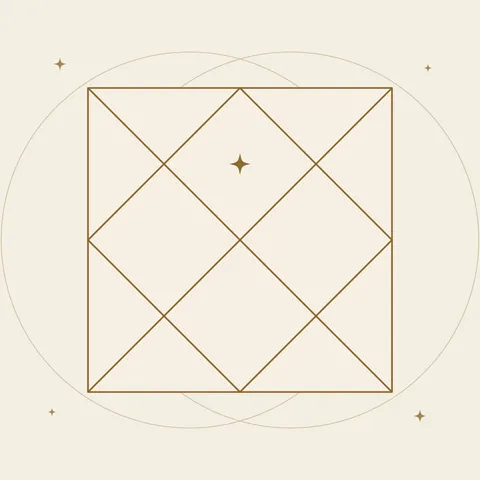
A kundli, also called a janam kundli or birth chart, is a diagram of the sky calculated for the moment and place of a person's birth. This guide shows how to read one in Vedic astrology, the traditional Indian system, in six steps: birth details, chart layout, the ascendant, the houses, the planets and the Moon's nakshatra. It also covers the main Hindi terms.
What a kundli is, and what it is not
A kundli is a calculated snapshot, not a picture you can look up in the night sky. In Vedic astrology it is read as a set of signs, houses and planets, each traditionally associated with certain themes. These associations are offered as a way to reflect, not as a verdict.
Step 1: Start with the birth details
A chart is calculated from three details: the date, the time and the place of birth. The place fixes the local sky, and the time matters most because the sky turns quickly.
If the exact time is not known, a chart can still be drawn, but the ascendant and houses may be less precise.
Step 2: Recognise the chart layout
Kundlis are drawn in a few regional styles.
- North Indian: a diamond divided into twelve spaces. The houses keep fixed positions, and the sign numbers change from chart to chart.
- South Indian: a square grid of twelve boxes. The signs keep fixed positions, and the ascendant is marked in one box.
In both styles, each space is a house, called a bhava (Sanskrit for a dwelling or place). Each house shows the zodiac sign, called a rashi, and any planets, called grahas, that sit in it.
Step 3: Find the ascendant (Lagna)
The ascendant, known in Sanskrit as the Lagna, is the sign that was rising on the eastern horizon at the moment of birth. Locate it first, because the houses are counted from it.
A new sign rises roughly every two hours. Two people born on the same day, a few hours apart, can therefore have different ascendants. This is why birth time carries so much weight in the tradition.
The sign on the ascendant becomes the 1st house, and the other signs follow in order. For a fuller explanation of the counting, see this guide to the 12 houses of the birth chart.
Step 4: Read the 12 houses in order
Each house is traditionally associated with a group of themes. The table is a starting point for reflection.
| House | Traditionally associated with |
|---|---|
| 1st | Self, body, outlook and personal direction |
| 2nd | Speech, family, savings and values |
| 3rd | Siblings, courage, short journeys and communication |
| 4th | Home, mother, comfort and inner peace |
| 5th | Creativity, learning, romance and children |
| 6th | Daily routine, service, competition and effort |
| 7th | Partnership and close relationships |
| 8th | Shared resources, research and deep change |
| 9th | Dharma (a person's guiding duty), teachers and long journeys |
| 10th | Work, public standing and responsibility |
| 11th | Gains, networks and friendships |
| 12th | Rest, solitude, expenses and distant places |
A beginner can start with three houses: the 1st for the self, the 7th for partnership and the 10th for work. To look at one house in depth, see the 10th house and work in Vedic astrology.
Reading a house through its sign and lord
A house is not read alone. The tradition looks at three things together:
- The sign that falls in the house.
- The planet that rules that sign, called the house lord.
- Any planets placed inside the house.
The rulers of the twelve signs are:
| Planet | Signs it rules |
|---|---|
| Mars | Aries, Scorpio |
| Venus | Taurus, Libra |
| Mercury | Gemini, Virgo |
| Moon | Cancer |
| Sun | Leo |
| Jupiter | Sagittarius, Pisces |
| Saturn | Capricorn, Aquarius |
Here is a short worked example of the counting. Suppose the ascendant is Gemini. Then Gemini is the 1st house, Cancer the 2nd, Leo the 3rd, Virgo the 4th, Libra the 5th, Scorpio the 6th, Sagittarius the 7th, Capricorn the 8th, Aquarius the 9th and Pisces the 10th. Pisces is ruled by Jupiter, so Jupiter is the lord of the 10th house in that chart. A reader would then note where Jupiter itself sits.
The tradition describes houses such as the 6th, 8th and 12th as themes that ask for effort, attention or reflection, not as areas to worry about.
See the report this guide is part of →
Step 5: Locate the planets
Vedic astrology works with seven visible planets and two shadow points. The Sanskrit names are:
- Surya (Sun)
- Chandra (Moon)
- Mangala (Mars)
- Budha (Mercury)
- Brihaspati (Jupiter)
- Shukra (Venus)
- Shani (Saturn)
Rahu and Ketu are the two nodes, the points where the Moon's path crosses the Sun's apparent path. They are shadow points, not physical planets.
Each planet sits in one sign and one house. A simple list of planet, sign and house gives a clear overview before any interpretation begins.
Step 6: Note the Moon and its nakshatra
The Moon holds a special place in Vedic astrology. Its position gives the nakshatra, one of 27 divisions of the zodiac. Each nakshatra spans 13 degrees 20 minutes and has four quarters called padas.
Each nakshatra is ruled by one of the nine planets. The ruler of the Moon's nakshatra sets the starting point of the Vimshottari Dasha. Dasha is a Sanskrit word for a planetary period, and this system divides a 120-year cycle among the nine planets. This explanation of the Mahadasha covers it in detail.
How to read a kundli in Hindi
In Hindi the chart is called kundli or kundali (कुंडली). The words janam patri (जन्म पत्री) are also used. The Hindi phrase कुंडली कैसे पढ़ें means "how to read a kundli". The vocabulary above translates directly:
- लग्न (lagna): the ascendant, the sign rising at birth
- भाव (bhav): a house
- राशि (rashi): a zodiac sign
- ग्रह (graha): a planet
- नक्षत्र (nakshatra): a lunar star division
The method is the same in any language: find the lagna, count the bhavas, place the grahas, then read them together.
Putting the steps together
A reading rests on connections, not on one house or one planet. A reader might note the ascendant, find the lord of the 10th house, see which house that lord occupies, and check which planets sit nearby. Each of these observations is a theme to reflect on.
Traditions describe these links, and they do not prove them. Many people find it useful to compare what the tradition says with their own experience, and to leave aside whatever does not fit.
For a personal chart set out in plain language, the Life Map reading is one place to see how these steps come together.
Common questions
Do I need an exact birth time to read a kundli?
A chart can be drawn without it, but the ascendant and house positions depend on the time. Without an accurate time, the houses may be less precise.
What is the difference between a rashi and a house?
A rashi is a zodiac sign, one of twelve, such as Aries or Taurus. A bhava is a house, one of twelve divisions of the chart counted from the ascendant. Any sign can fall in any house, which is why the two are read together.
Why does my Vedic sign often differ from my Western sign?
Vedic astrology uses the sidereal zodiac, which is measured against the fixed stars. Western astrology commonly uses the tropical zodiac, which is tied to the seasons. The two systems are offset from each other, so the same birth date often gives a different sign in each.
Going further
The AATMIC Life Map is one detailed report of about 3,500 to 5,000 words built from your calculated chart, covering your core pattern, your chart explained, strengths, tensions to watch, reflective suggestions and a numerology section, with the method shown. It needs your birth time.