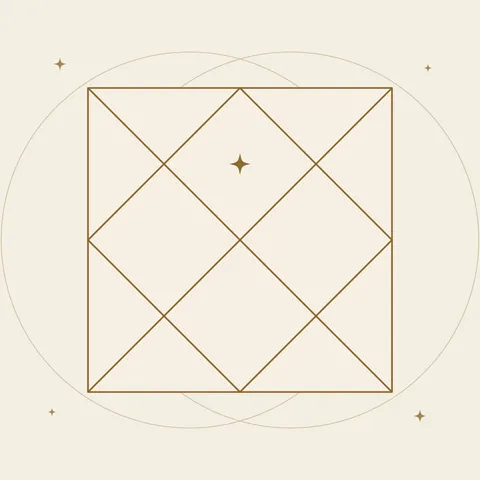
The 1st house, called Lagna Bhava in Sanskrit, is where every Vedic birth chart begins. Lagna means the ascendant, the sign rising on the eastern horizon at the moment of birth, and bhava means house. This article explains what the 1st house is traditionally read for, how to locate it in a chart, and how to use it for reflection rather than as a verdict.
What the 1st house is traditionally read for
Vedic astrology, called Jyotisha in Sanskrit, counts twelve houses from the lagna. The 1st house is also known as tanu bhava, where tanu means body. In tradition it stands for the self as a whole: temperament, physical form, energy and the general way a person meets the world.
Readers usually group several themes under this house:
- Personal identity and the sense of who someone is
- Physical build, appearance and general constitution
- Energy, initiative and the way a person starts things
- First impressions and overall approach to life
The other houses are counted outward from this one. The 2nd house is traditionally read for resources and speech, the 3rd for effort and courage, and so on around the chart. Each of them is understood in relation to the self that the 1st house describes. For a full tour of all twelve, see our guide to the 12 houses of the birth chart.
A reference point for the whole chart
Traditional texts sort the houses into groups. The kendra houses (the 1st, 4th, 7th and 10th) are called angular, because they mark the main axes of the chart. The trikona houses (the 1st, 5th and 9th) are called trinal and are linked in tradition with purpose and learning in a broad sense.
The 1st house belongs to both groups. That is one reason it is described as the anchor of the chart. This is a description of how the tradition organises a chart, not a statement about any individual.
How to find your 1st house
Locating the 1st house takes three steps.
- Gather your birth date, birth place and birth time, as exact as you can make it. The rising sign changes roughly every two hours, so a gap of even a few minutes can sometimes move the lagna into a neighbouring sign.
- Use a chart calculated for that place and time. A kundli (Hindi for birth chart) usually marks the rising sign directly, often with the number 1 or the letters Asc or Lg.
- Note the sign in that position. That sign is the lagna.
In the whole-sign method, the entire lagna sign counts as the 1st house. Other house systems place the start of the house at a calculated point called the cusp, which can fall partway through a sign. Because the method changes the boundaries, it is worth knowing which one a chart uses. Our article on what a chart needs before it is read explains why time, place and method each matter.
The lagna lord: ruler of the rising sign
Every sign has a ruling planet, called its lord. The lord of the lagna sign is read together with the 1st house, and the house and sign it occupies are among the first things a reader looks at after locating the lagna.
| Lagna (rising sign) | Lord |
|---|---|
| Aries | Mars |
| Taurus | Venus |
| Gemini | Mercury |
| Cancer | Moon |
| Leo | Sun |
| Virgo | Mercury |
| Libra | Venus |
| Scorpio | Mars |
| Sagittarius | Jupiter |
| Capricorn | Saturn |
| Aquarius | Saturn |
| Pisces | Jupiter |
Mars, Venus, Mercury, Jupiter and Saturn each rule two signs, while the Sun and Moon rule one each. Rahu and Ketu are shadow points (the lunar nodes), not physical planets, and they do not appear in this table.
A reader might ask which house the lagna lord sits in and what that house is traditionally associated with. For example, a lagna lord placed in the 10th house would lead a reader to look at how the self connects with work and public life. It is a prompt for reflection, not a conclusion.
Planets in the 1st house
When a planet occupies the 1st house, traditional readings colour the picture of the self with that planet's qualities. These are common associations, offered as reflection points:
- Sun: self-expression and a wish to be seen for what one does
- Moon: emotional sensitivity and a responsive, adaptable manner
- Mars: drive, directness and a quick start on new things
- Mercury: curiosity, speech and a liking for learning and exchange
- Jupiter: a broad outlook and a teaching temperament
- Venus: charm, taste and an interest in harmony and beauty
- Saturn: patience, discipline and a theme of steady effort over time
Rahu and Ketu are also read in this house, usually in terms of the unusual or less conventional ways a person may present themselves, and again only as a theme to consider.
No planet is read on its own. Traditional readers weigh its sign, its lord and the other planets that look upon the house before drawing any picture. An empty 1st house is also common and simply means the reader leans more on the lagna lord.
See the report this guide is part of →
Self, body and approach to life: questions to reflect on
The 1st house is most useful as a set of questions. These have no fixed answers and are not tests:
How do I usually begin something new: with energy, with planning, or with caution?
How do other people tend to describe their first impression of me, and does that match how I see myself?
Which kinds of movement, rest and routine seem to suit my own energy?
Tradition offers vocabulary for these questions. The reader decides what fits their own life.
Reading the 1st house with the rest of the chart
The 1st house is one part of a larger picture. Readers also look at the Moon sign, called rashi, and the Moon's nakshatra, one of 27 lunar divisions of the zodiac, each spanning 13 degrees 20 minutes. Our article on lagna, rashi and nakshatra shows how these three reference points differ and how to find each one.
The same lord-and-house method applies to other houses too, such as the 7th house of partnership, which is covered in our article on the 7th house.
For a plain-language walk through how the houses and planets sit together in a personal chart, the Life Map reading is described on its own page.
What the 1st house cannot tell you
The 1st house does not fix character, and it does not describe the course of a life. It records what a tradition associates with the self and the body. A chart is one lens among many and sits best beside a person's own experience and judgement.
It also cannot be read well from a guessed birth time. If the time is not known exactly, the lagna and every house boundary may shift, so any reading should be treated as provisional.
Common questions
Is the 1st house the same as the ascendant?
They are closely linked. The ascendant is the rising degree and sign, called the lagna, and the 1st house is the house built from it. In the whole-sign method the lagna sign is the entire 1st house. In other systems the house begins at a cusp that may sit within or near that sign.
Do I need my exact birth time to find my 1st house?
Yes, the birth time is needed to find the rising sign. Because the ascendant moves into a new sign about every two hours, a small error can sometimes change the lagna. If the time is only approximate, treat the result as provisional.
Does the 1st house decide my personality?
It is traditionally read as a main reference point for temperament and approach to life, but no single house is read alone. Think of it as a set of questions to reflect on, not a definition of who a person is.
How is Lagna Bhava different from the Moon sign?
Lagna Bhava is the 1st house, counted from the sign rising at birth. The Moon sign, or rashi, is the sign the Moon occupied at birth. Traditional readers use both, and each answers a different question about the chart.
Going further
The AATMIC Life Map is one detailed report of about 3,500 to 5,000 words built from your calculated chart, covering your core pattern, your chart explained, strengths, tensions to watch, reflective suggestions and a numerology section, with the method shown. It needs your birth time.